FELIX FANPAGE
Hello!!!! This is a page dedicated to my FIRST jumping spider - Felix (/pheonix depending on how I am feeling), I got him and his enclosure from the lovely people at Jumping Spiders Web, he is an adult Phidippus regius Everglades male. Or so I believe?
 Here he is right after I got him! He came with a bit of tissue paper where he had already made a hammock :)
This is my Nerd Section abt enclosure + husbandry + CIC + feeders

I will say, I use hot glue RELIGIOUSLY in building these. Keep in mind that it's not the best for holding up everything... Sometimes super glue/magnets are your friend too! When using adhesives etc, make sure you air out the enclosure even after its cured as our arthropod friends are a lot more sensitive to these things and may die.
"Everett, What did you mean by Custodians?"

Custodians, Clean Up Crew, whatever they're called - it refers to isopods (and springtails) that you "seed" your substrate with. Isopods are detritivores, meaning they consumed decaying organic matter - rotting wood, leaf litter, mostly eaten flies that the spider discards... They are very important to keeping your substrate and enclosure clean :) Likewise, springtails feed on mould! Nobody wants mould to overtake their vivarium.
I have a personal interest in keeping isopods, and have started a springtail culture as I need them for many terrariums/vivariums to come. I am also keenly interested in insect husbandry, and it is very important to me that I can give these creatures a good quality of life - even the flies I use to feed my spider. Aside from the fact that a happy fly that has had its fill of food will be more nutritious and potentially enriching to the spider, I try to be kind to something that I am essentially sending to its death.
I am going to refrain from my "hierachy of sentience does not mean no sentience/experience, and we should aim to practice good husbandry regardless of something's final destination/apparent worth to us, because at the very least - we have chosen to be responsible for this life, and you should take good care of the things you are responsible for" ramble.
I have kept dairy cows as CUC successfully before, but can recommend with full confidence that dwarf white isopods are much less risky to your spider and just as useful :) Although, you may have to remove feeder carcasses.
- - - - cross-posted to the dairy cows' page - - -There are lots of different pieces of information about dairy cows. Some people report them to be incredibly aggressive, and they are known to be aggressive towards other isopods - so should not be kept in a mixed colony. Other people describe them eating parts of a live lizard while it sheds, eating the skin off their fingers, eatings entire tarantulas alive. Others consider them completely harmless to most active predatory species of inverts. Other people consider them to be completely safe custodians but recommend keeping an eye on them with inverts. Other people say it depends on the size of the reptile, or that they cannot eat parts of reptiles at all.
I bought them quite early on, not fully understanding that while they are considered very effective and safe clean-up crew, that does not mean for all pets.
What do I know about them definitively? Dairy Cows are very active when established and confident, and the juveniles are particularly protein hungry. They are incredibly efficient and will devour anything I put down for them. Ensuring they have a regular source of protein and supplementary feeding in addition to burying feeder carcasses has worked without problem for me so far. But, I'd rather there was no risk at all to Felix even if he spends his time far above them, especially as he ages. And, I can still remove the fly carcasses and put them into the separate colony to be recycled. We know that some inverts like millipedes cannot be housed with procellio at all, for example. So, I am in the process of removing them as custodians and replacing them with another alternative which have a completely harmless nature to the spider. These characteristics though, make them absolutely perfect to keep in their own colony!
- - - - end of crosspost - - -LET THE REAL FANPAGE SECTION BEGIN
05/17or18/26 : I fed Felix a fly that had been living it up for a couple of weeks in an enclosure I call 'Fly Heaven'. And because of a certain someone, all the flies in Fly Heaven are called Fly Heaven. Fly Heaven is named because its supposed to be the best the fly life is going to get! Warmth, comfortable damp sphagnum moss, fresh food and water, space to perch and fly and maybe even play.
I fed him a little bit earlier than usual, and he had a lot of time chasing after it, practicing the jumps and calculating distances - he's not very good at it yet! But, I hope the experience was enriching for him and that he's able to hone his skills further. I really enjoyed watching him and cheering him on. I'm sorry Felix that I picked you up when you weren't wanting me to! I was trying to help, and I thought that because you had gotten onto my hand, it meant you would be totally cool with me lifting you up to where you'd fallen from. Evidently, I was wrong...
But, you have been staring at me a lot while I work on my arts and crafts in front of your enclosure, and looking at me when I talk to you while showing you interesting things (how to thread a needle). So maybe you've forgiven me?
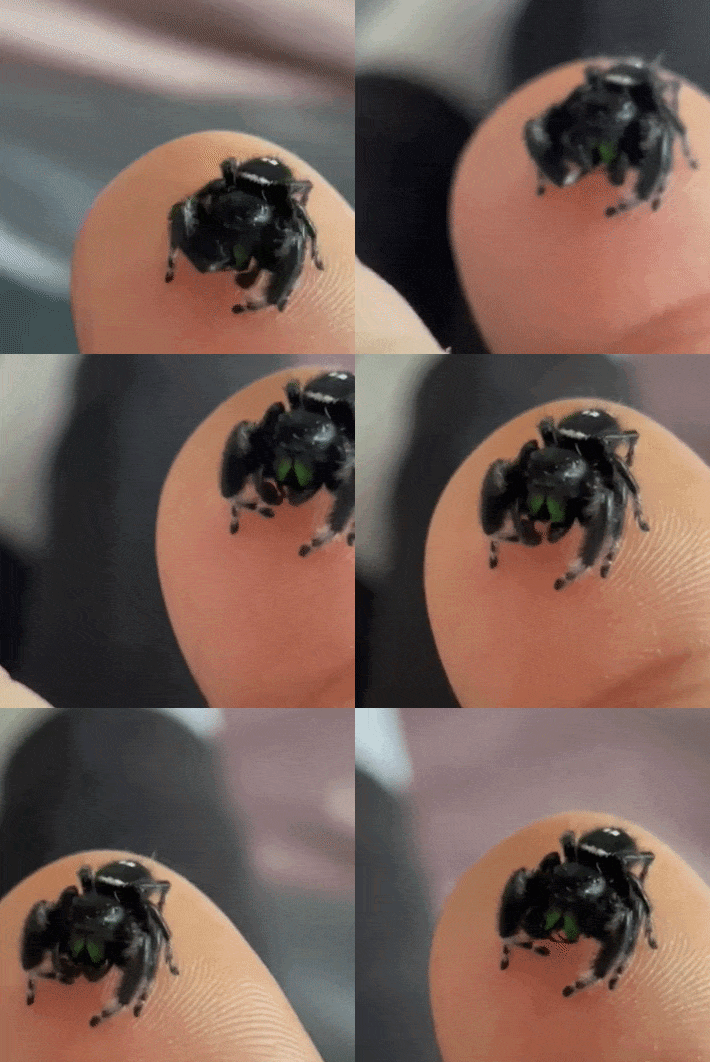 Eating a fly surrounded by the warmth of my hand... he had to come with me while I brushed my teeth, made toast, ate breakfast, etc.
 I was really surprised when he initially went onto my finger to eat. I tried everything to encourage him to move to a leaf or otherwise. But eventually he just stopped... caring about my finger wagging in his direction and hunkered down. This was also his fastest hunt! As soon as I put the fly in there he tackled it to the ground. I was trying to help him onto a higher ledge as I haven't removed all the dairy cows yet... so I was really happy about this happening on accident.
 Out and about >:)
 First time outside! Since then he sometimes approaches me and crawls onto me to be put outside on another plant.
 I really enjoy watching him eat.
 He is very comfortable with my presence now :)
 His first meal with me!
