page navigation: intro | methods & materials | gameplay & practicals | gallery
Inscryption IRL
I really enjoy the game mechanics of Inscryption and DM/GM'ing, so this was an ambitious art project as well as me wanting to make a storytelling table-top experience with the mechanics of a card game. You can read about my review of the game in my Reading List under Video Games.
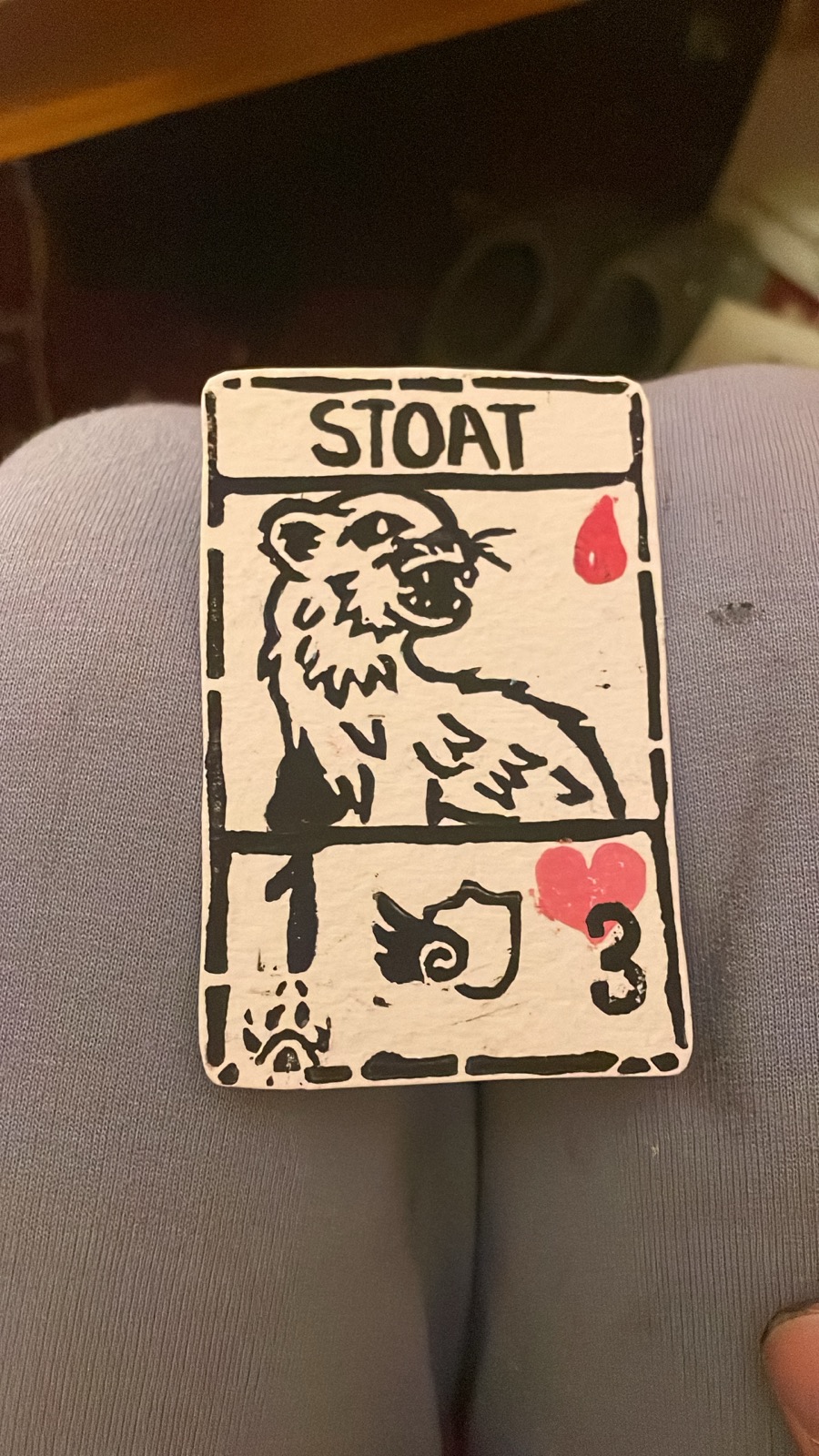
I am using Vladde's Inscryption Cards PDFs, specifically act 1. I mirrored the PDF files so that the linocut prints correctly oriented. I don't have too much of an interest in creating non-Leshy cards, simply because I don't care for PvP as much.
Materials and Methods
I use Easy-cut Lino of different forms. Anything that's advertised as softer and easier to carve into, I prefer. I'd recommend against blue easy-cut from Specialist Crafts just because it's super crumbly so isn't the best for continuous ongoing use. I'm also not the gentlest with things.
I treated myself to 3mm Soft-cut Esdee Lino a while ago and am quite happy with my choice! I reccomend colouring the top of the lino though, so it's easier to tell where you've actually cut into it. I use a white-board pen for that, but I'm sure there are better alternatives.
I'm linking to Jackson's art (which I do use) but I tend to buy from Cass Art in the brick-and-mortar stores, there's also Edinburgh Art Shop or Scrap Antics in Dundee, if you want to check out local stores! I'm fond of Specialist Crafts because they were the suppliers for my school's Art Department.
A lot of the materials, I did end up getting for free. Because they were free, they are second-hand so the blades as quite dull for my lino cutters. That's almost done me in a couple of times so I finally ordered some new blades while I research how exactly to sharpen these things.
I'm using ABIG's Lino Cutting Tool - Handle and Set of 5 cutters. But literally anything works, ESDEE is a huge UK retailer for Lino printing tools and they work lovely. Only thing I would recommend against them is their block-printing fabric ink. Maybe the worst ink I've ever used. It'll work, but at the cost of a lot of time, sanity, and just get the Speedball one. It's more expensive but it's so worth getting a good ink.
My normal water-based block printing ink is literally the cheapest I found on the shelf. It's printing onto card, it's fine, it works.
People have put thin magnetic sheets inside a printed card, but I am sticking to just uhhh sticking blank sale stickers that they use on stores on them for now.
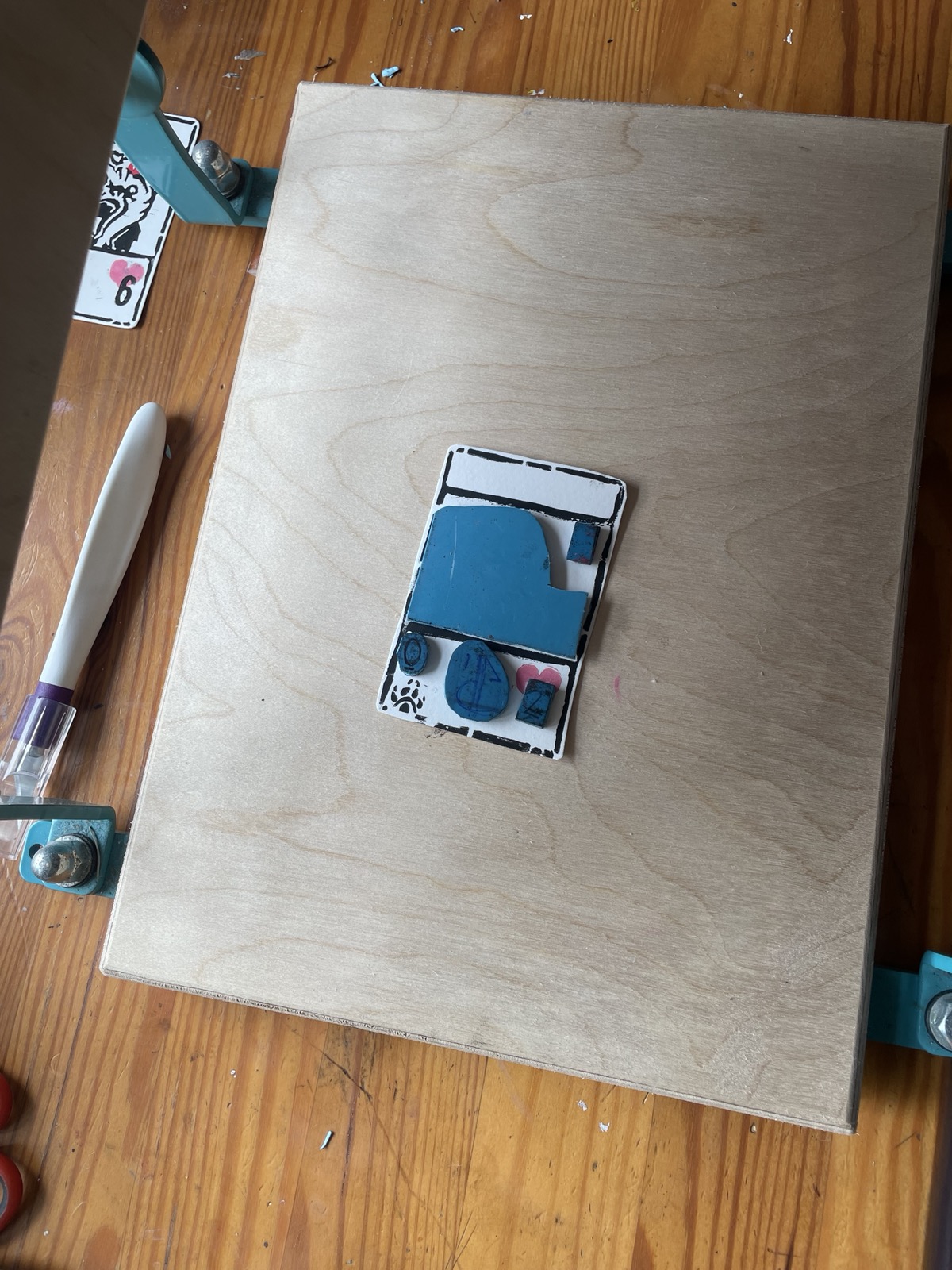
Anyways, I draw onto the Lino with a ballpoint, and then carve it, and then print.
I have a Pooki A5 printing press that I got off Gumtree for 60 bucks! Quite pleased with it. I had to get it after all my hand joints started screaming at me from putting pressure through them too much. I know that tortilla presses also work well for small things? Or so the social medias say.
Points are counted by a linear scale from 0-5 in two directions. There is a counter that represents how close either of us are to winning, and I put magnets under the strip of cardboard beneath each number so it snaps in place (it also has a magnet.)
Gameplay + Practicals
One day, I'd like to have a complete recreation of the video-game setting. So, a working scale with clay or wooden teeth that I carve out for it. Actual candles, or, LED ones that I can turn off for dramatic effect. I'd like a little bell to signal the end of the turn as well.
That being said, that is Leshy's Inscryption, and I'm making Everett's Inscryption. For my version of the game, I am prioritising portability and ease of use as well as coolness factor. I'm not going to play a game with mechanics that annoy me, after all.
While I don't have the physical totems and items etc, I am making quickly drawn 'cards' to represent them. It's times like these I yearn for a 3D-printer.
Right now, the multiplayer mode is just two players sharing a caravan of animals. I'd really like to introduce battles where the playing board is expanded, or change the way that the map works - like in Grimora's Act 3 game. I'm not really sure how to optimise enjoyment for a party, for example, but I'd like to figure that out eventually.
My main problem right now is to make sure that players know that they will be rewarded for taking risks. I think it's done really well in the tutorial map of the game where the player is forced to use the campfire the first go-around. And is introduced to some other game mechanics, all positive. I tend to reassure more nervous players outside of character (meta), but I like my immersion, so I want to see if I can somehow get that point across through the gameplay itself.
Here is some unorganised thoughts that I need to put into coherency at some point:
My aim with my Inscryption is to engineer a game that is, ultimately a fun challenge. I like to be more flexible with encounters and card choices, because I want to optimise the fun and make sure that even if things are difficult it is not impossible. I want people to lose through misplays, forgetting about certain enemies, or forgetting/being too stingy about their items.
Essentially, I will adjust the difficulty of the game depending on the player for the optimal experience. My fun comes from trying to balance player experiences and battle pacing. I really enjoy listening to and watching players make decisions. That helps me better understand my role.
The starting deck that is given is significantly expanded, with bone cards, a card with a special sigil, more costly cards that are not rare - e.g. grizzly. It would be interesting to theme these animals based off a brief explanation of why the player character is journeying. That being said, because I remember which builds players have leaned towards, I can tailor it to be a slightly new experience each time.
It is more fun for the player to feel like they have more choices that they are able to make, rather than that they are making the only optimal choice. So, the deck should be a little bloated with one-cost cards or low number bone cards, as you can just give the player more opportunities to slim down their deck once they get a hang of things, and it starts to impact strategy.
When presented with card choices, I tend to give 5 card options for common cards, and 4 for rare cards.
Deathcards will be very rarely included, definitely as part of the rare card pull.
The first couple of battles, I will be tuning the difficult completely down. I draw from my catalogue of cards and slot them in front of me so I know which cards i should put down. The battles increase in difficulty, and my own decision making becomes mostly not thought out quick plays (with consideration for how many points these enemies will deal), to more calculated barrages.
I am now quite familiar with early game balancing, getting familiar with mid-game, but have not reached end-game scenarios yet. My bosses tend to be packs of wolves, terrain changes, default deathcards as survivors with a special focus in certain creatures, etc.
In my Inscryption, probability includes me asking the player(s) to pick a number between 1-10, and depending on the probability chance - example: 60% success, I will 'mark' a random 4 (for 40% fail rate) numbers in my head or write it down. If they picked any of the marked numbers, they do not succeed, if they don't, they do. This is portable (literally in my head), and makes the player feel more in control. Pay-off is more satisfying, and failure can be blamed less on the dice.
Movement between waves of enemies is something I have now play-tested (although not too much). It involves normal inscryption battles, but in fast succession. The player has the opportunity to forfeit their turn to play probability for the chance to 'skip' the wave - their character moves past the previous attackers somehow. If they succeed, it is a fresh set of enemies on the board, with some attackers already in play. This works for sequences such as travelling through caves to the other side of the mountain, hostile camps, etc. The punishment is that they have skipped their attacking turn, so they need to be able to tank an additional round of damage.
The magnetic whiteboard I use as the canvas for the map and all the little icons with magnets. That being said, I don't use this anymore because I can just tell the players their diverging paths and how far they can see ahead (usually two to three paces).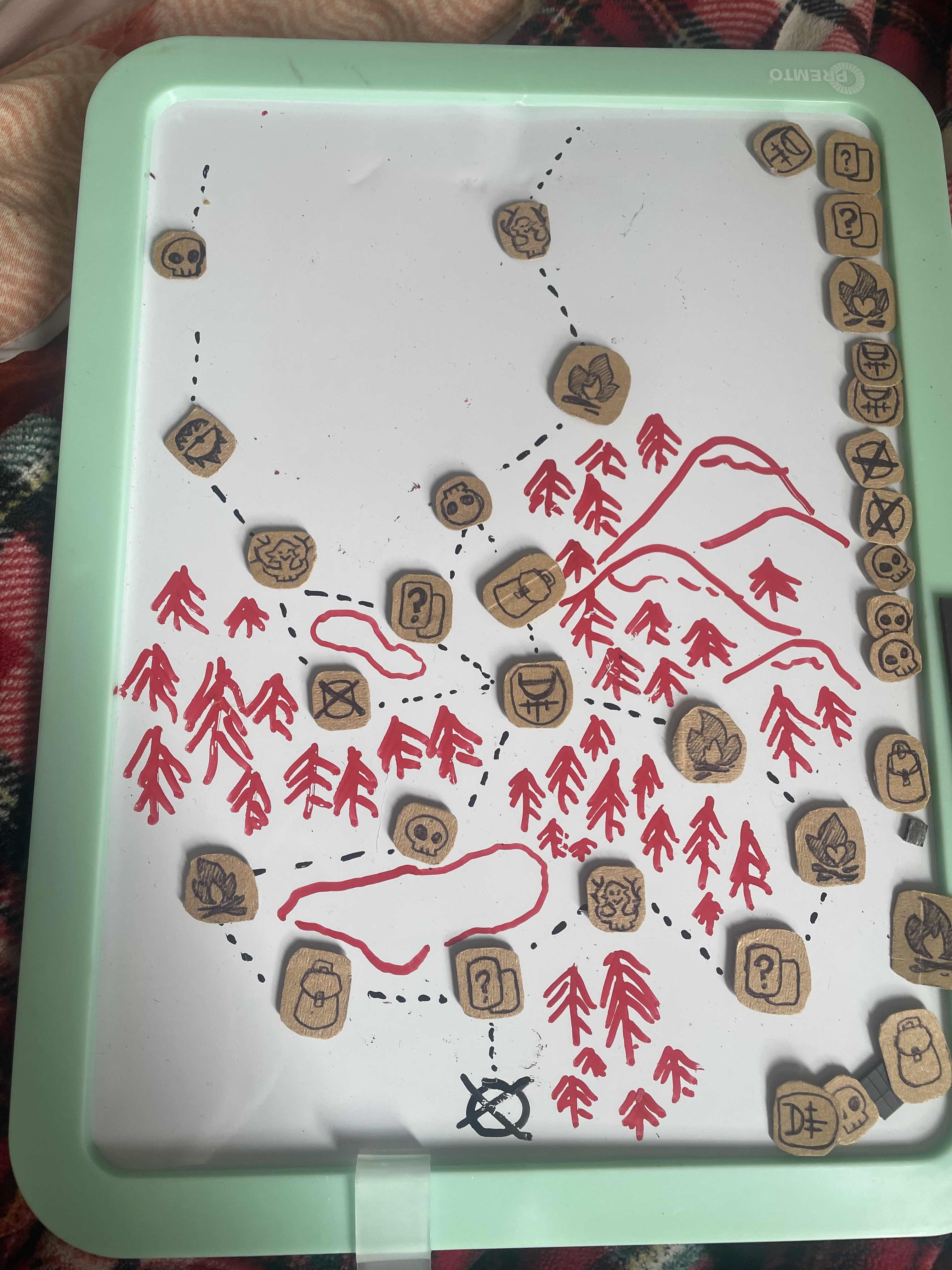
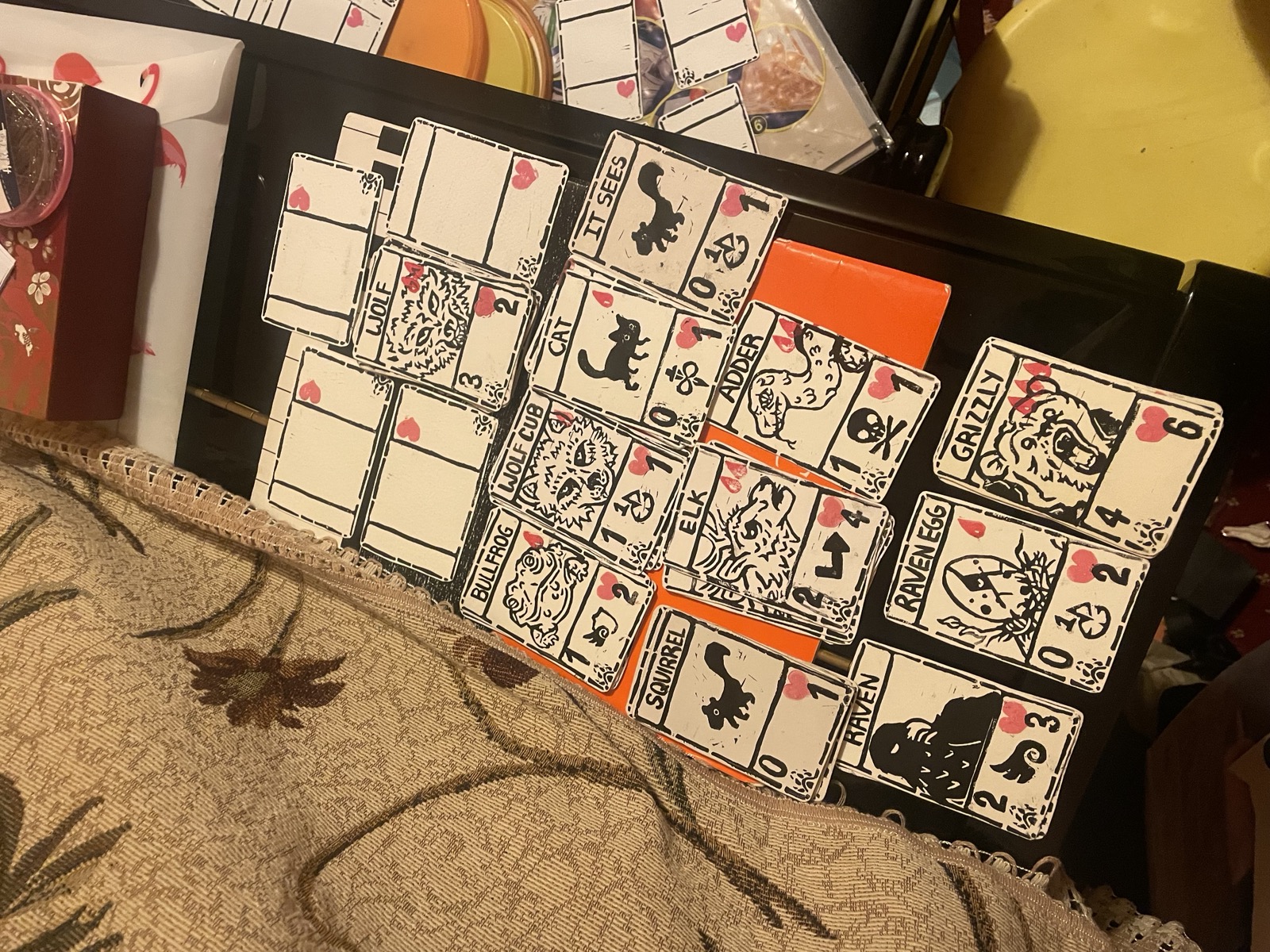
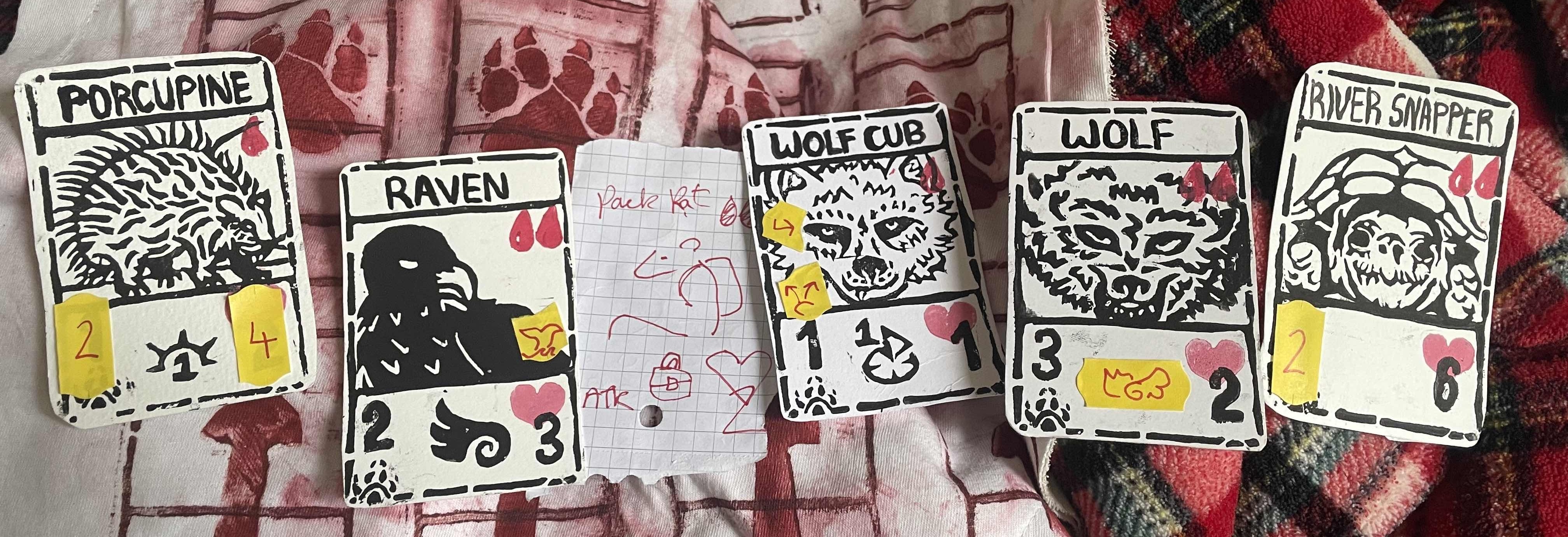
Aaaand, here's an example of the kind of deck you can end up building :) We're not too far into the game - still mid/early game.
Gallery
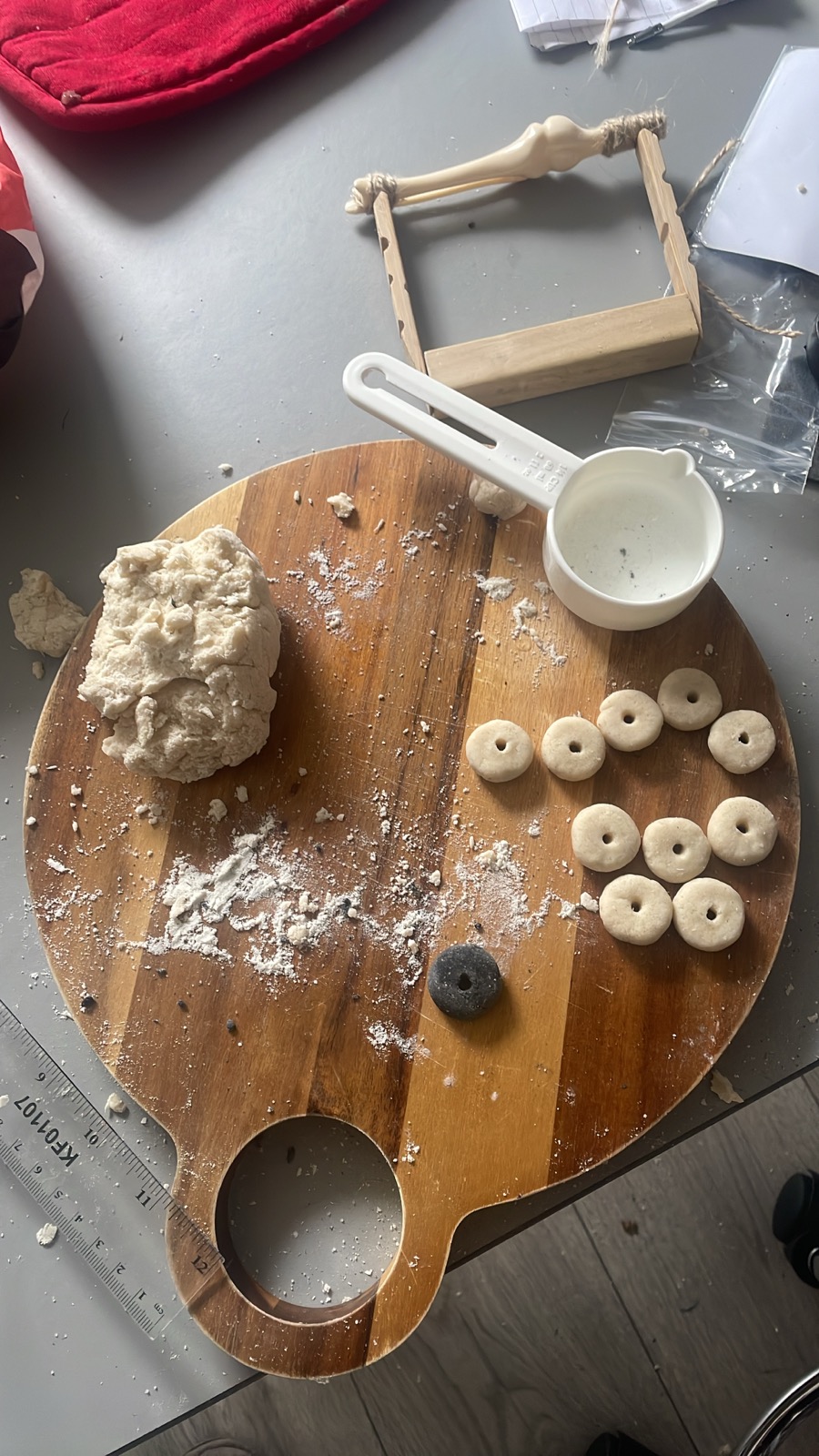
07/09/26 So... there's been a lot of updates over the past couple of weeks. I've been really hyperfixating on this, and have been able to playtest this quite a lot. I now have a two tiered chinese abacus that I made to count bones, a much more space-efficient and generally more useable catalogue of cards. I used a expandable document organiser to store, and extended the lid/cover with a cardboard delivery envelope. Anyways, enjoy the picture updates:


 Enjoy the deck that my lesbian friend built and her death card :)


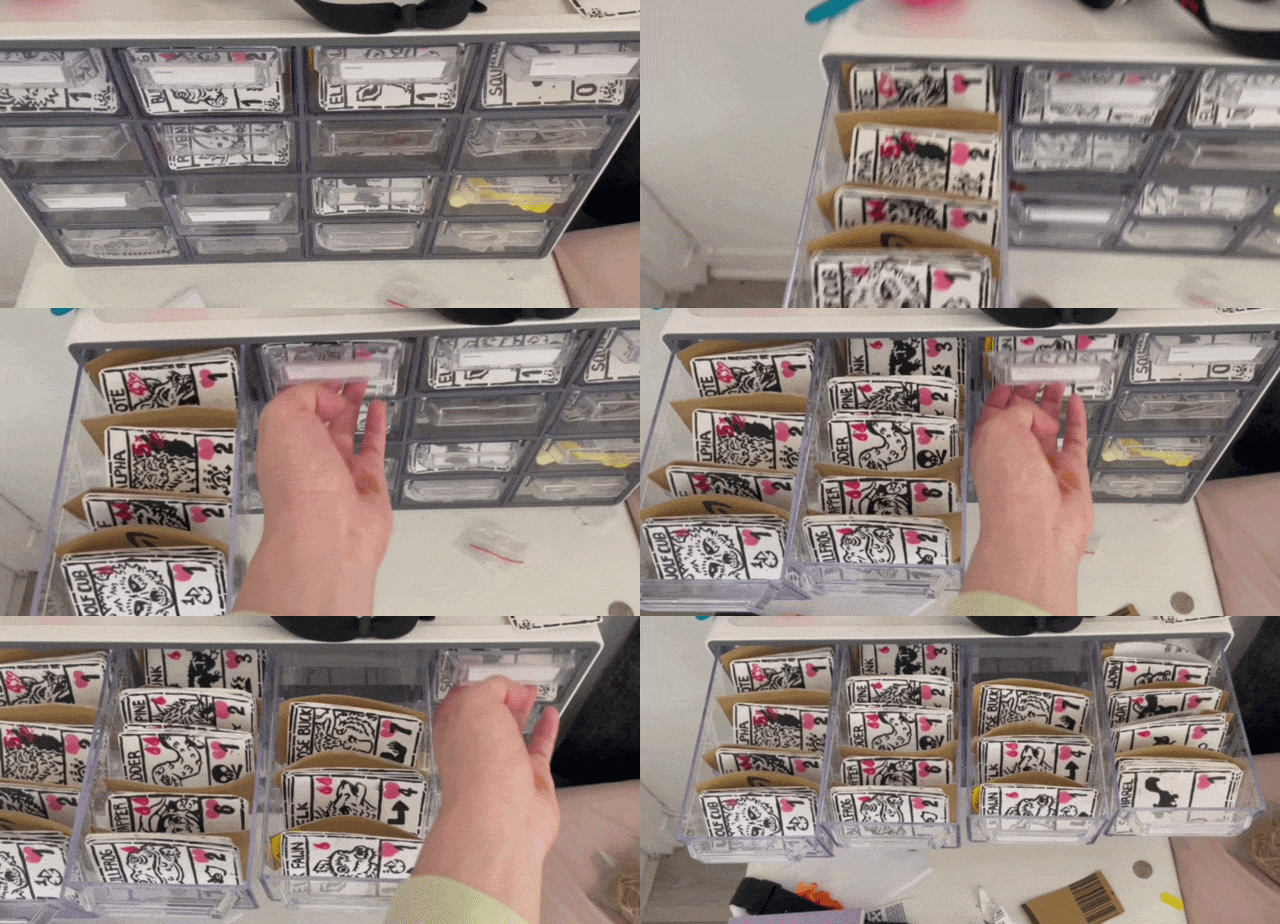
 05/28/26 Working on organising the display case for better ease of use.
 So, some stamp carving has been in progress but not done yet. I drew up some totems and item cards so that it's easier to keep track of it all during the game. And so I don't have to hastily scribble down items in real time.


05/27/26

All below c.08/??/25